


The confusion begins
Imagine you started a gender transition in 2009. After years of questioning, you decide to stop. You feel a pull to present in a way that aligns more with your childhood—a possibility you’d never considered before. You don’t know anyone who has done this; you’re not even sure if it has a name.
You search online for “stopping hormones transgender,” but what you find only confuses you further. Some sources say you are “detransitioning.” Others call it “stopping/reversing transition” or a “retransition.” In forums, people talk about “desisting.” Academic articles use phrases like “non-linear gender transition” or “dynamic gender identity.” A few articles describe people who simply “discontinue” treatment; others speak of “regret.” Other academic papers explicitly warn against using the word “detransition” at all, calling it politically loaded or harmful.
Little by little, you realize there’s a waterfall of words for what you are experiencing: gender journey, non-linear transition, dynamic gender identity, detransition, discontinuation, retransition, identity fluidity, desistance, reversion, regret.
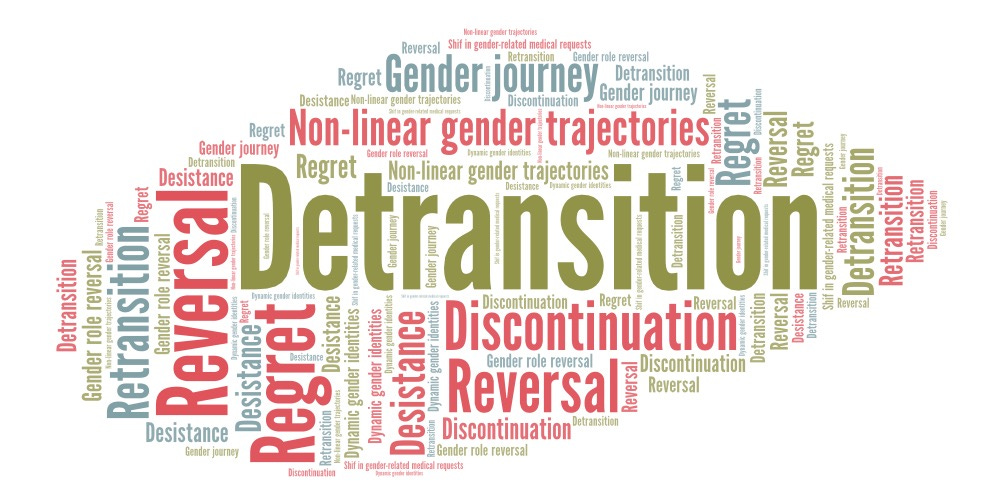
So why have so many new terms and concepts popped up for naming the act of stopping or reversing an initial gender transition?
The power to define
For decades in the trans medical literature, the broad set of experiences now understood as “detransitioning” was largely contained under a single term: “regret.”
This reflected a concrete way of thinking about medical gender transition during the “gatekeeping” era, the early professionalization of transgender medicine that occurred from approximately the 1960s until the early 2010s. “Regret” was the term used by clinicians to capture outcomes that surprised them because they deviated from typical male-to-female or female-to-male transitions. These were outcomes that seemed, at the time, to defy the underlying objective of transgender medicine to align the body with the mind. And it reflected how sexology and psychiatry thought about gender identity and transsexualism at the time, that it was immutable.
However, as the conversation about increasing access to transition-related care grew louder into the late 2010s, that precarious consensus fractured. Around 2018-2020, detransition experiences became more visible—in public discourse, in gender-critical activism, and professionally with the field of gender care. Soon after, the number of academic and community terms used to describe detransition-related experiences multiplied.
But consider this: if the word “detransition” is the term that is most widely used by individuals with lived experience and understood by the public—online and offline—how do we make sense of the introduction of so many new terms and concepts by the field of gender care?
There is little focus on detransition care in the World Professional Association of Transgender Health’s most recent standards of care, version 8 (SOC 8), except to state multiple times that detransition is “rare.” When the SOC 8 was released for public review, it intially used the term “retransition.” Presumably, the final version shifted to the use “detransition” following feedback received during the public comment period.
But this is not only occurring within mainstream transgender care, but also within gender-critical clinician spaces and some detransition communities themselves. Here, we see terms such as “disenchanted transsexual” or being “lost in transition.”
We believe this struggle over terminology is deeply influenced by a broader cultural and intellectual shift, rooted in poststructuralist thought, that reshaped how we think about language, identity, and power. From this perspective, language does not merely describe reality; it actively creates it. Words are understood as a form of power that can uplift or oppress.
As an example, speaking about the word “detransition,” the main author of the 2018 American Academy of Pediatrics’ gender-affirming care policy said in an interview with Reuters in 2022 that “detransition” is a “very invalidating term.” This keen focus on language—the belief that finding the “correct” terminology can prevent linguistic, epistemological, and even material harms—underlies the drive to define, redefine, and control vocabulary imagined to be unjust.
But when institutions and clinician-leaders decide which words are legitimate, they not only shape public discourse but they may also shape and constrain how individuals can understand and describe their own life stories. A patient whose gender identity/sexual orientation identity changed post-treatment, who is grieving their pre-transition body, and has not reached a psychological state of acceptance of body changes that impact their social, sexual, and interpersonal lives, may scoff at the idea that they are on a “non-linear gender journey.” Likewise, someone who shifted from a binary trans man identity to nonbinary woman, and who feels euphoria with presenting feminine some days, androgynously others, may resent being labelled as “lost in transition.”
Subtypes, replacements, or rebranding?
In the professional arena, the ongoing debate about detransition terminology has fractured into what we see as three competing camps: the “typologists,” the “abolitionists,” and the “euphemists.”
The “typologists.” This camp advocates for retaining the term “detransition” but using typologies to make sense of its diversity. They create subcategories based on motivations for detransitioning or feelings about transition. This is a useful starting point, but the growing number of typologies also risks creating its own confusion. This camp generally believes that studying detransition is important for understanding all patient outcomes. (As researchers, we generally align with this camp and we have already produced detransition typologies, as have some others such as detransition with and without regret.)
The “abolitionists.” This camp argues for abandoning the term “detransition” altogether, believing it is too broad, politically charged, and epistemologically or existentially harmful to transgender medicine. They instead suggest using a set of more precise, descriptive categories. For example, instead of just saying “detransition,” one might distinguish between “regret regarding gender-affirming medical care” or “evolution regarding conceptualization of one’s gender identity.” Yet, if a goal in academic medicine is to accurately study, understand, and describe all outcomes from treatment, especially for fully informed decision-making, this approach risks creating clinical jargon inaccessible to patients and the public. In our view, the push comes from a defensive clinical position, offering a way to acknowledge adverse or unexpected outcomes without using a term they feel has been co-opted by a political project aiming to restrict gender-affirming healthcare.
The “euphemists.” This camp also avoids the word “detransition.” But instead of precise terms, they opt for equally broad, gender-affirmative expressions like “dynamic gender identities,” “non-linear gender trajectories,” or “retransition.” This language is a hallmark of the gender-as-a-journey philosophy that marked the period of affirming care’s institutionalized expansion: a focus on identity fluidity, breaking binaries, and individualized journeys. These new expressions allow disappointments and anomalies to gender-affirming healthcare to be reframed and rebranded into an affirming narrative, transforming a potential existential crisis into just another stop on the “gender journey.”
While the “abolitionist” and “euphemist” approaches are well-intentioned and even may help destigmatize detransition, from a sociology of medicine standpoint, they may also obscure and minimize the significance of some detransitioner patient experiences. Describing a person’s profound regret and loss of a core identity after life-altering surgeries as a “non-linear gender trajectory” can feel like pouring salt in a traumatic wound. To patients who feel harmed or misled by “gender-affirming” treatments, these terms can feel like an evasion of professional responsibility.
Indeed, we see the growth of this terminological chaos as a strategy being deployed within the field of trans medicine to manage a disciplinary crisis in the wake of detransition experiences and research. Calling an experience “detransition” or “regret” acknowledges it as a distinct outcome, one that may require accountability and recognition from the medical system. In contrast, calling it a “dynamic gender identity” reframes it as a natural, individualized aspect of an individual’s transition “journey,” deflecting potential criticism of the professional knowledge base and clinical care model that facilitated it.
Ultimately, language is not a neutral descriptor, but a tool. In our view, the explosion of expansive language surrounding detransition has become a new space for managing the field’s challenges, functioning to deflect professional recognition of detransition. The focus on terminology, while sometimes well-intentioned, has served to obscure rather than clarify it.
If transgender medicine is to step up to the task of producing data-driven care, it must learn to listen as carefully as it speaks.
Comments are open below
If you’re interested in how language shapes our understanding of detransition, you may also want to read our article “Are More People Detransitioning?”, where we explore similar questions about terminology and meaning.

If you’re interested in reading about the latest empirically-driven research on detransition from a “typologist” perspective, check out a recent post on Psychiatry at the Margins.

Thank you for reading The One Percent!
If you enjoyed this post, please share it with your friends, family, or colleagues:
You can also subscribe for free to receive new posts and support our work:
Our minds do not create reality. They occupy reality.
Love the work you folks are doing.
convo emphasizes people drawn into gender fiction are strongly linguistic thinkers. but not so skilled in math. but the math is where all the propaganda is. claims like gac actually helps (theres no medical evidence it does) or that few detrans (most do).
all the gender industry ever had to do was create docs and narratives that look legit and splash a gender propaganda headline at the title. the actual words below the headline that contain math no one reads that.
""The prevalence of discontinuing hormonal treatments among TGD youth and young adults ranges from 2-30% (Expósito-Campos et al., 2023)"
not sure if you ever looked at this opinion article that claims to be a "study". the say they got their data from an internet search. usually internet searches yield activist misinformation including narrowly focused info. you wont find counts of people who simply walked away. the truth is no one knows how many regret, stop taking gender meds, ect. but we know narrowly focused #s and meaningless online polls produced by activists shouldnt be portrayed as representative. IOW, its just more gender biz misinfo that harms vulnerable people. its medical quackery.
"HHS invited three organizations that have spent years insisting that “gender-affirming care” for minors is safe, effective, life-saving, and evidence-based: the American Academy of Pediatrics (AAP), the American Psychiatric Association (APA), and the Endocrine Society. This was their chance to show the public the solid data behind those claims.
Two of the three didn’t bother. The AAP and the Endocrine Society simply refused to participate."
https://www.realityslaststand.com/p/eager-to-affirm-yet-unwilling-to-e79
"