

Notes on Nonbinary Identity
A guest post by Clare Ashcraft, who takes us through gender exploration of the 2020s.


Our guest post today is not a story about detransition/retransition. It features personal writing about gender theory, internet culture, and gendered meaning-making. It hints at identity construction of the 2020s—identity exploration and gender deliberations that cuts across some detrans experiences we have encountered in our own research over the last few years.
Clare Ashcraft writes The Mestiza, where she makes observations about identity, psychology, and culture. She is a proud Ohioan.
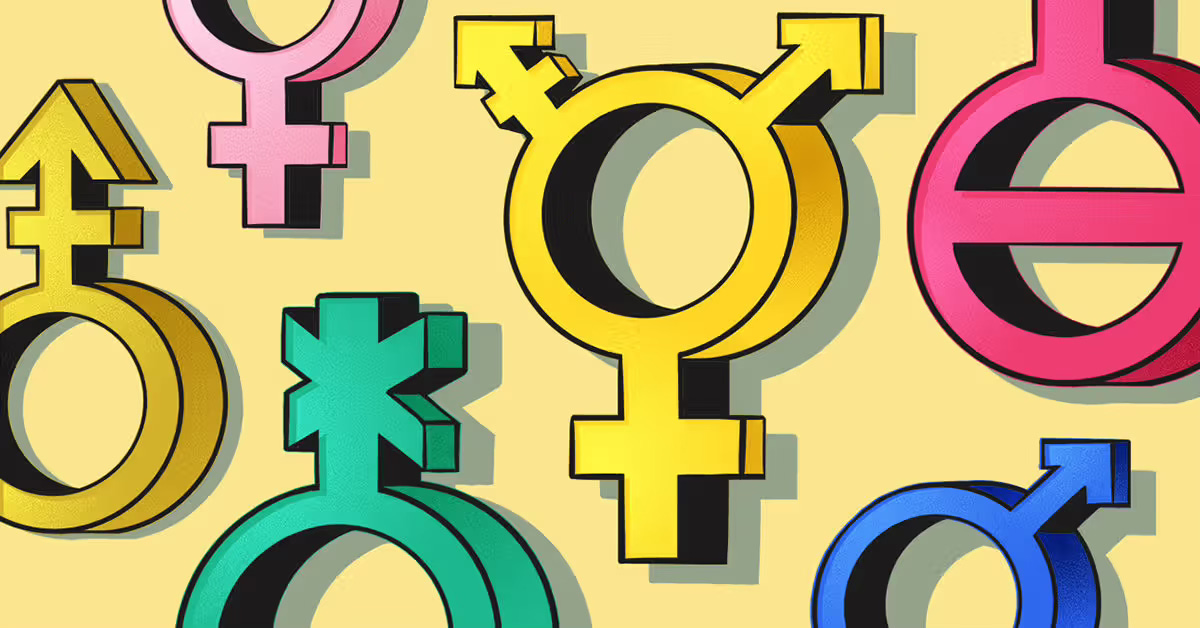
The One Percent occasionally features guest writing about gender fluidity, transition/detransition/retransition via personal narratives. If you are interested in sharing your writing, feel free to reach out.
I have friends on all sides of the gender identity issue. Many of my friends reject the idea that nonbinary is a coherent identity, some to the point of assuming that nearly all trans people are brainwashed into “gender ideology.” Then, I also have friends who are nonbinary. Each side seems so confident in themselves and their position. So, I’m reluctant to admit, my head and heart are often on different sides of the divide.
I’m not convinced that the idea of more than two genders is coherent politically or philosophically, but if nonbinary identity is coherent as a category, I think it describes me.
Part of the reason I always felt it was necessary to give nonbinary identity the benefit of the doubt is because I trust my friends and their intelligence. I’ve been told that my experience of the world isn’t real before, and it sucks, I wouldn’t want to impose that feeling on anyone else. So I asked them questions, and when they were willing to give answers, I listened. I asked what being nonbinary meant to them, and often got a vague answer about not really fitting in, feeling like the nuclear family and the stereotypes of women didn’t fit for them (most of my nonbinary friends are lesbians). I asked about the difference between being nonbinary and, say, a butch lesbian and often got an answer along the lines of “a butch lesbian or masculine woman still feels like a woman and identifies as a woman. Nonbinary folks aren’t women.” To which I asked what it meant to “feel like a woman.” No one can seem to answer that one.
It’s a tricky and potentially unfair question that I’m not sure I could answer either, but if someone is saying that they are decidedly not a woman and they expect society to change to accommodate that, it seems like they should have an idea of what a woman is. If their idea of a woman is based on stereotypes they don’t want to articulate, many would say they should broaden their view of what a woman is. If their idea of a woman is so broad that they cannot contain it in a definition (e.g. anyone who identifies as a woman) then why must it be something that you must differentiate yourself from?
I began a years-long contemplation on gender sympathetic toward understanding gender diversity, but I came out the other side of my studies leaning toward the idea that it didn’t make sense. It wasn’t philosophically consistent. At a certain point, I asked myself “What am I missing?” so many times that the only question left to ask was “What if I am right? What if I am not missing anything?”
Still, that question troubles me because I too have that vague sense I don’t quite fit in the ‘woman’ category.
When I first heard the term nonbinary it confused me. I didn’t understand how you could be both a man and a woman or neither, because my whole life I had been told those were the only two options. Being, at the time, further to the left than I am now and already understanding myself to be bisexual, I trusted leaders in the LGBTQ+ community were expressing something real and true. Just because I didn’t understand it did not mean it wasn’t valid and I became eager to educate myself on the subject.
I remember coming across a podcast about religion with a nonbinary guest and briefly they described what it was like growing up before understanding their gender and it sounded an awful lot like the way that I felt growing up. Then, understanding nonbinary identity became more urgent. It wasn’t just about respecting what others wanted to be called, it was about understanding if this was a category that described me.
The first order of business was understanding what it meant to be a man or a woman. The idea of being both or neither was completely foreign to me, so I had to understand how the terms were being used in this new context. I watched documentaries from psychologists, from philosophers Judith Butler and Kathleen Stock, and yes, even Matt Walsh’s What is a Woman? No matter how many podcasts I listened to, documentaries and YouTube videos I watched, or lectures I attended I could not wrap my head around how gender significantly differed from gender roles on the more-than-two-genders model and why the insistence we had to differentiate gender from biological sex.
Judith Butler is considered to be one of the founders and leading advocates of the model. Butler is a postmodernist thinker who, in the simplest terms, says that gender is what you do not who you are. It is a social script given to you by a combination of “cultural norms, historical formations, family influence, psychic realities, desires and wishes” that you perform. This definition sounds to me quite like a gender role, with the addition of the desire and wish to be identified as and act out that gender, which does not do much to illuminate how they are using the term gender.
I think that Butler has often been unfairly demonized by the right. I think it’s silly to be afraid of ideas, and I don’t wholly disagree with much of what Butler says—we do, of course, act and perform in certain ways due to being a man or woman. Our obligation to philosophers, living and dead, is to wrestle with their ideas and to either establish objections or integrate them into our expanding world view and with Butler I have wrestled.
It’s important to note that Butler argues that gender is something that is not a fixed internal identity but something made and remade by our actions. So, in some ways, the identity politics side of the left has changed Butler’s original conception by arguing there is some sort of “gendered soul” wherein a child has “always known who they are inside” and that gender identity is an “inner truth.” Butler’s original theory is more coherent than the amalgamation of gender ideology most have been exposed to online. However, it’s unclear to me why we need more genders in Butler’s view (for context, Butler has legally changed their gender to nonbinary).
Butler says that gender is a domain of freedom, and I wonder why freedom means creating new categories rather than expanding the categories that currently exist i.e. expanding what it means to be a man or a woman, as we seemed to have been working towards for decades before this new gender debate took center stage. On this question, Butler has said that we can simultaneously expand what it means to be a man or a woman and have other genders. While that does provide freedom for people to identify however they feel, it’s philosophically inconsistent. If the definition of woman is broad because society deems it to be, then how is nonbinary different from being a woman? If there is no societal consensus about how they are different then how can we continue to function as a society in gender segregated spaces, such as single gender schools or prisons? Everyone doesn’t have to agree on everything, but on many topics society must have a semblance of consensus to make things easier, for example we must have a consensus of what counts as “slander” or “speech” or “harm” for our legal system, and we have to have concepts of what we mean by “education” and “health” to understand the rules and roles of education systems and healthcare. Thus, to have single-gender prisons, we must have a general consensus on gender.
Given what I have read of Butler’s theories (and I am no expert), it seems clear to me however interesting their ideas are to consider or play with, it’s not a theory that society can function based on. It seems to me only rooted in the idea that we should be able to be whoever we want to be free from discrimination. But total freedom leaves us with nothing but confusion. There’s no basis for why anyone should or shouldn’t identify a certain way. If you tell people growing up that they can identify with their birth gender, and that can look an untold variety of ways, or they can identify as something else, nonbinary or another gender, which can also look an untold variety of ways, without clear demarcation or difference (even a blurry difference for that matter), you’ll end up with a bunch of people like…well, like me.
Even if the jury’s still out on whether it makes sense to call it another gender, undoubtedly there is something crucial that nonbinary people are describing, a common experience—I think I get it—and it’s becoming harder for me to ignore.
A few weeks ago, a woman asked me what I liked to do, saying, “I only have one daughter, so I’m constantly trying to figure out what’s normal for girls.”
“I don’t know either,” I said before I could think. “I mean, I just do what I like. I read, listen to podcasts, cook. I’m not sure what’s normal, I don’t worry too much about that. It’s just what I like.” I suppose some of my hobbies are “feminine” but some part of me immediately rejected being looped in with the “normal woman” not because anything is wrong with women, but because the idea of “normal” is so rife with assumptions that probably don’t track and, frankly, the “normal woman” is a mystery to me.
The other day someone on a dating app asked if he could talk to me to “help his social anxiety with talking to girls.”
My gut reaction, though I didn’t say it, was “bro, I don’t know how to talk to women either.” I am just as mystified as any man about what the modern woman wants when it comes to dating. Then, I felt almost misleading. The photo he liked was one of me in a jumpsuit with daisies on it and my hair curled. I looked, by all accounts, like a girl, but I didn’t feel like it 100% was me. I never do my hair (aside from pulling it out of my face) or do makeup. In fact, before those photos were taken I wanted a short masculine haircut, but my hairdresser whom I’ve known since I was a baby, refused to do it before my senior pictures so I didn’t “ruin” them. I felt like maybe I had deceived him into the impression that I was a woman and therefore he could talk to me through the lens of my being a woman, but I just want to be a person.
Yesterday my friend texted our group chat of three, “Boys we are SO going to mars” (he’s a SpaceX fan, what can I say). And I smiled, not because I’ve ever felt like a “man” or “boy” but because the pronoun felt like an acknowledgement that I was “one of the boys” meaning I was connected with them and my gender wasn’t prohibitive of having close bonds with men. I have often felt more parallel to men, standing shoulder to shoulder with them, than adversarial, trying to vie for their affection.
There are some things I understand about women as a result of being female, what it’s like to experience menstruation, the pressure to look a certain way, etc. But in other ways I feel like there was a handbook for womanhood that was never passed down to me. I don’t have a maternal instinct. I don’t change in front of other women, which some bi and lesbian women seem unselfconscious about. I don’t ever wear skirts and extremely rarely dresses. The odd occasion I have worn a dress and even thrown on mascara I have looked in the mirror and thought I looked quite pretty, but also not like myself.
I did baton (dance) for eight years, like, it seems, every other girl in the country, but I hated the costumes. I never fit in with the other girls and I was occasionally described as “powerful” but never graceful.
Of course, none of these things individually are what it means to be a woman, but collectively it feels like something close to womanhood.
I especially noticed in my freshman year of college, my first time living with a roommate, how different our lives were. We had similar views of the world, and I could see in her what my life could have been, yet hers was so different. Having her boyfriend over on her frilly purple bed, inviting her friends over to help her pick a going out top and modeling her new clothes for them. Those were experiences I never had and didn’t entirely understand the appeal of. My side of the room was beige and literary. I only left it for class, food, university and club events, or to go do manual labor in the theater where I worked.
I’ve frequently found myself relating to conversations about male friendships and “toxic masculinity” including it being difficult to open up, cry, etc. At times I feel like I have been simultaneously striving for the masculine and feminine ideal.
Historically, women’s value has been placed in their appearance, which we see today in the marketing for skin care, weight loss products, laser hair removal, botox, etc. While for men, historically, value has been placed in their status and economic security. Men are still often expected to provide more financially and, in the shallowest form of masculinity, have the cool car and the trophy wife. There is a good amount of crossover between the two, where women face more pressure to be a “boss babe” and men to be more emotionally aware and to have a particular height, size, and body type. But if we assume the historical trends still mostly apply, I’ve gotten so anxious about my weight that I have starved myself. I’ve been so focused on status and security that I graduated early, in part, to save money and get a job earlier. I’ve always been career focused. It’s difficult for me to understand how to open up emotionally, and, similar to many men who tend to look externally instead of internally to ‘fix’ their lives, I can’t seem to stop feeding my ambition to optimize every aspect of myself and I am prone to trying to solve my emotions instead of experiencing them.
It’s hard not to wonder if I’ve made this all up. If I have spent too much time on the internet trying to find myself, pathologizing and theorizing about an experience everyone goes through: feeling other.
I’ve been silently considering this prospect for years because it never felt urgent, like I needed to label myself and announce it to the world, I just wanted to understand myself really. To confirm I wasn’t totally off the rails, I asked one of my closest friends, whom I’ve talked to everyday for nearly three years, whether he perceived me as more masculine or feminine or both or neither. He said, “I’d say both and neither work…To be honest you’re pretty tricky to pin down. I’d say you’re probably more on the masculine side.”
It would be disingenuous for me to pretend that other people’s perception of me doesn’t play a factor in all of this.
I did once try out putting “they/she” in my bio on a social media app, but it felt more like projecting my political ideology then being some sort of authentic version of myself. I think a young college-educated nonbinary bisexual vegan atheist who’s not on the left might genuinely make people’s heads explode. And, let’s be honest, being a nonbinary bisexual centrist would not be beating the “can’t pick a side” allegations.
Jokes aside, I enjoy being contrary to expectations and appreciate when people are curious about my experiences, but it can be difficult to feel constantly misunderstood and I’m not sure that I want to publicly add another layer of confusion.
It seems unreasonable for me to expect others to leave space for complexity that I, as ashamed as I am to admit, haven’t left either. I’ve historically assumed that most nonbinary people are on the illiberal “woke” left and that our values likely wouldn’t align, which is wrong of me.
Beyond that, even if I were to adopt “nonbinary” as a new descriptor of myself, I have a hard time forcing others to adopt new language that is essentially dependent on them agreeing to Judith Butler’s philosophy (or a version of it). It feels like an imposition to ask others to refrain from calling me a woman or girl when they believe that is what I am, and importantly, I’m not sure I disagree with them.
Philosophically, I tend to believe that being a woman or a man can be expansive. I imagine there are two overlapping bell curves of men and women where some women are so masculine they overlap with the more feminine men and vice versa. Women who are on the very far end of that bell curve would be those with dysphoria who may want to transition to a man because it’s more in alignment with their temperament. But if being a woman is as diverse as women decide that it is, if it’s this big bell curve, then it’s mutually exclusive with three or more genders. In theory, you could say that after a certain point on the bell curve one becomes nonbinary because they are in the center region occupied by some biological men and women, but that makes less sense societally than simply being a masculine woman.
From what I can gather, the experience of being nonbinary is the expression that one feels alienated from the biological sex they were born as and the gender expectations that accompany their biological sex. I feel that alienation too, and I too feel the pull to announce my alienation so that people might stop making assumptions about my experience. I feel intuitively, not just that I don’t fit in either gendered box, but that I want people to see both my masculine and feminine elements. So, I suppose it wouldn’t be untrue for someone to refer to me as nonbinary. Yet, I cannot think of or justify any system in which it practically makes sense to separate gender entirely from sex.
Okay, so I’ll bite: What is a woman? My best guess is this: A woman is a gender; gender being a socially constructed marker that indicates the shared experience of a group based on their biological sex, and their sex norms, roles, and expectations. There are varying degrees to which everyone identifies with and feels in alignment with their expected sex-based norms and social roles. Gender is an imperfect system that does not capture these nuances well—which is why if someone is deeply disturbed by the misalignment between sex-based expectations and who they are, they may choose to transition to the other gender. However, because the very definition of gender is tied in part to one’s experience as their biological sex, unless someone has dysphoria, it doesn’t make sense to change the system of gender that we have in place. Although the current gender system is not comfortable for everyone, including myself, without a more expansive view of gender norms and expectations, revising the system to include new genders defies the very definition of gender and would become a different concept entirely.
With apologies to the postmodernists, gender is more than performance, even if the whole idea of what constructs gender is a bit ambiguous at times. It’s not not a performance. It’s not wholly biological, but it is rooted in something—in cultural and scientific realities—even if norms shift over time. I share the expansive intuitions about gender with the left without sharing their downstream conclusions.
So, I won’t be cracking out new pronouns just yet, but it wouldn’t hurt for those who consider themselves opposed to “gender ideology” to have a little more empathy for those who feel perpetually misunderstood within the current system of gender.
Thank you for reading The One Percent!
If you enjoyed this post, please share it with your friends, family, or colleagues:
 | A guest post by
|
Hi Clare. I enjoyed reading this. I am the author of a forthcoming book on nonbinary identity (The Third Person, 2027) that deals with some of these ideas as well. I would be interested to read more of your thoughts on the identity’s political valences. If I’m reading correctly, you seem to regard it as something mostly belonging to the “illiberal ‘woke’” left but simultaneously point out that it seeks validation via liberal regimes of recognition (for instance, Butler changing their sex marker). I am curious where you fall politically and if you have any thoughts on this tension.
I love the openness and questioning in this piece. We need more room for that in online spaces. I distinctly remember being a teenager in the 80's cringing whenever an adult said I was going to grow up to be a woman. I said "I want to be a person" I am bi/pan and monogamously married to a cishetero male who was raised by his mother and has a lot of healthy gender balance. I flirt with the concept of nonbinary although there is a part of me that identified strongly with second-wave feminism with gender as a social construct and roles being restrictive and a science fiction fan waiting for androgynous jumpers for everyone😎. I have been attracted to a person because of their energy and intelligence , not necessarily their gender. I have never felt a biological urge to nurture children. I am also into Goddess and Earth based spirituality. Nature has many expressions beyond our human binary. Yet I have never felt an urge to change my pronoun (unless I could use Marge Piercy's pronoun "per" for "person" from her book "Woman on the Edge of Time") but I've heard the term "Gender Expansive" and it resonates more than "nonbinary". What interest me more is creating a world that prioritizes nurturing the next generation as a human project not just one gender. And allowing that generation to unfold and grow without being forced into a chosen or societal role.